
What is Base? Coinbase’s Ethereum Layer 2 Network
Last updated
Written by

Reviewed by


Table of Contents
- Overview: Why Coinbase Built Base
- Architectural Foundations: How Base Works
- Settlement, Finality, and Ethereum Dependence
- Gas Fees and the Absence of a Native Token
- Sequencing, Control, and Trust Tradeoffs
- Ecosystem Growth and Adoption Dynamics
- Base Compared to Other Major Ethereum Layer 2 Networks
- Why Base Matters in the Ethereum Ecosystem
- Conclusion
- Frequently Asked Questions
Overview: Why Coinbase Built Base
By 2022, Ethereum’s scaling path was clear. Rollups would handle execution, while Ethereum mainnet would focus on settlement and security. What remained unresolved was who would build Layer 2 networks capable of onboarding users at scale.
Coinbase’s decision to build Base was driven by the view that Ethereum’s limitations were no longer purely technical. High fees, fragmented tooling, and complex onboarding flows continued to prevent broader participation. For a platform already serving tens of millions of users globally, these frictions represented a structural bottleneck.
Base was created to reduce this friction while preserving Ethereum’s security model and developer ecosystem.
Architectural Foundations: How Base Works
Optimistic rollups by design
Base uses optimistic rollups, executing transactions off Ethereum and submitting compressed transaction data back to mainnet. Transactions are assumed to be valid unless challenged during a defined dispute window.
This design significantly lowers transaction costs and increases throughput, while still relying on Ethereum as the final arbiter of state. The tradeoff is that full economic finality depends on Ethereum settlement and the rollup’s challenge mechanism.
The OP Stack and strategic alignment
Base is built using the OP Stack, the open-source rollup framework developed by Optimism. This makes Base fully EVM-compatible, allowing Ethereum smart contracts and tooling to function with minimal changes.
By adopting the OP Stack, Base aligns itself with the broader Superchain vision, where multiple Layer 2 networks share infrastructure, standards, and interoperability. Rather than differentiating through custom architecture, Base differentiates through integration, distribution, and execution.
Settlement, Finality, and Ethereum Dependence
Transactions on Base are executed on Layer 2 but ultimately settled on Ethereum. Ethereum remains the final source of truth, ensuring that Base inherits Ethereum’s validator security and censorship resistance at the settlement layer.
From a user perspective, transactions appear final quickly. From a protocol perspective, full finality depends on Ethereum confirmation and the rollup’s dispute window, a characteristic shared across optimistic rollups.
Gas Fees and the Absence of a Native Token
Base does not have a native network token. Transaction fees are paid in ETH.
This design choice reduces complexity for users and avoids introducing speculative incentives at the protocol layer. By using ETH for gas, Base remains economically aligned with Ethereum rather than fragmenting liquidity across additional assets.
As of 2026, Coinbase has stated it is exploring the possibility of a Base token, but no launch, specifications, or timeline have been confirmed.
Sequencing, Control, and Trust Tradeoffs
Base currently uses a single sequencer operated by Coinbase. The sequencer determines transaction ordering before batches are submitted to Ethereum.
This approach improves reliability and performance, particularly for consumer-facing applications, but it introduces a trust assumption. While Ethereum enforces settlement, Coinbase retains control over transaction inclusion and ordering at the execution layer.
Base follows a phased decentralization roadmap aligned with the OP Stack, including fault proofs and shared sequencing. Progress has been made, but Base should currently be viewed as partially decentralized.
In practical terms, using Base today requires trusting Coinbase to operate the sequencer honestly and reliably, while trusting Ethereum to enforce final settlement and asset recovery. Over time, this trust assumption is expected to shift away from a single operator as sequencing and fault proofs are decentralized. Until then, Base occupies a middle ground between fully permissionless execution and fully centralized infrastructure.
Ecosystem Growth and Adoption Dynamics
Base’s adoption has been driven primarily by access rather than token incentives. Integration with Coinbase’s infrastructure simplifies fiat onboarding and reduces friction for users moving on-chain.
This has made Base attractive for consumer applications, NFT platforms, social protocols, and low-fee DeFi use cases. By 2024 and 2025, Base consistently ranked among the most active Ethereum Layer 2 networks by transaction count and active addresses.
Base’s ecosystem growth has also been shaped by visible Coinbase leadership, including Jesse Pollak, who has played a prominent role in representing the project publicly and engaging with developers as the network has expanded.
Base Compared to Other Major Ethereum Layer 2 Networks
The following table compares Base with other major Ethereum Layer 2 networks across architecture, governance, and ecosystem focus.
| Feature | Base | Arbitrum One | Optimism | zkSync Era | Polygon zkEVM |
|---|---|---|---|---|---|
| Launch year | 2023 | 2021 | 2021 | 2023 | 2023 |
| Backed by | Coinbase | Offchain Labs | Optimism Collective | Matter Labs | Polygon Labs |
| Rollup type | Optimistic | Optimistic | Optimistic | ZK rollup | ZK rollup |
| Execution environment | EVM-compatible | EVM-compatible | EVM-compatible | EVM-equivalent | EVM-compatible |
| Settlement layer | Ethereum | Ethereum | Ethereum | Ethereum | Ethereum |
| Gas token | ETH | ETH | ETH | ETH | ETH |
| Native network token | None (as of 2026) | ARB (governance) | OP (governance) | None | None |
| Sequencer model | Coinbase-operated (single) | Centralized, roadmap to decentralization | Centralized, roadmap to decentralization | Centralized | Centralized |
| Governance model | Coinbase-led, decentralization planned | DAO-led | Collective governance | Foundation-led | Foundation-led |
| Primary focus | Consumer onboarding, scale | DeFi infrastructure | Public goods, governance | High-performance apps | zk-based scaling |
| Token incentives | None | Governance incentives | Governance incentives | None | None |
| Ecosystem maturity | Rapidly growing | Highly mature | Mature | Growing | Growing |
Why Base Matters in the Ethereum Ecosystem
Base illustrates a different approach to Ethereum scaling. Rather than competing through aggressive incentives or bespoke architecture, it prioritizes compatibility, distribution, and reduced onboarding friction.
For Ethereum, Base serves as a case study in how Layer 2 networks can drive adoption without fragmenting standards or security assumptions. For users, it offers a lower-cost way to interact with Ethereum while remaining within a familiar ecosystem.
Base is less focused on serving governance-heavy, DAO-native communities and more focused on applications that benefit from simplified onboarding, predictable costs, and tight integration with existing crypto infrastructure.
Conclusion
Base is a deliberately conservative but strategically significant Ethereum Layer 2. By combining optimistic rollups, EVM compatibility, and Coinbase’s distribution reach, it occupies a distinct position among Ethereum scaling networks.
While decentralization remains a work in progress, Base demonstrates how infrastructure design choices and distribution strategy can influence real-world adoption without abandoning Ethereum’s core principles.
Frequently Asked Questions
Is Base its own blockchain?
Base is a Layer 2 network that executes transactions off Ethereum but settles them on Ethereum mainnet.
Does Base have a token?
No. As of 2026, Base does not have a native token and uses ETH for gas.
Is Base decentralized?
Base is partially decentralized and follows a roadmap toward greater decentralization over time.
Why did Coinbase build Base instead of using an existing Layer 2?
Coinbase built Base to reduce onboarding friction, control the user experience, and align Ethereum scaling with its existing infrastructure.
Who is Base best suited for?
Base is well suited for users and developers who want lower fees, Ethereum compatibility, and access to consumer-focused on-chain applications.
Want to explore advanced trading features?
Visit orangerock.xyz - Bitcoin.com’s pro-trading experience for serious traders.
Related guides
Start from here →
What is Ethereum?
Understand Ethereum's key characteristics.
What is Ethereum?
Understand Ethereum's key characteristics.
What is layer 2 on Ethereum?
Layer 2 is an umbrella term to describe solutions that build on top of Ethereum mainnet (layer 1) to improve the scalability of the Ethereum network.
What is layer 2 on Ethereum?
Layer 2 is an umbrella term to describe solutions that build on top of Ethereum mainnet (layer 1) to improve the scalability of the Ethereum network.

Blockchain Layers Explained
A deep dive into the different layers of blockchain technology, from Layer 0 to Layer 3, and their role in the crypto ecosystem.
Blockchain Layers Explained
A deep dive into the different layers of blockchain technology, from Layer 0 to Layer 3, and their role in the crypto ecosystem.

ZK-Rollups vs. Optimistic Rollups
Compare ZK-Rollups and Optimistic Rollups and understand their impact on blockchain scalability.
ZK-Rollups vs. Optimistic Rollups
Compare ZK-Rollups and Optimistic Rollups and understand their impact on blockchain scalability.

What are Altcoins?
Altcoins are cryptocurrencies beyond Bitcoin. Learn about their diverse functionalities, use cases, risks, and potential.
What are Altcoins?
Altcoins are cryptocurrencies beyond Bitcoin. Learn about their diverse functionalities, use cases, risks, and potential.
What is DeFi?
Learn what makes decentralized finance (DeFi) apps work and how they compare to traditional financial products.
What is DeFi?
Learn what makes decentralized finance (DeFi) apps work and how they compare to traditional financial products.
What's a dApp?
Discover what dApps are, how they work, advantages and disadvantages, and more.
What's a dApp?
Discover what dApps are, how they work, advantages and disadvantages, and more.

STAY AHEAD IN CRYPTO
Stay ahead in crypto with our weekly newsletter delivering the insights that matter most

Weekly crypto news, curated for you

Actionable insights and educational tips

Updates on products fueling economic freedom
No spam. Unsubscribe anytime.
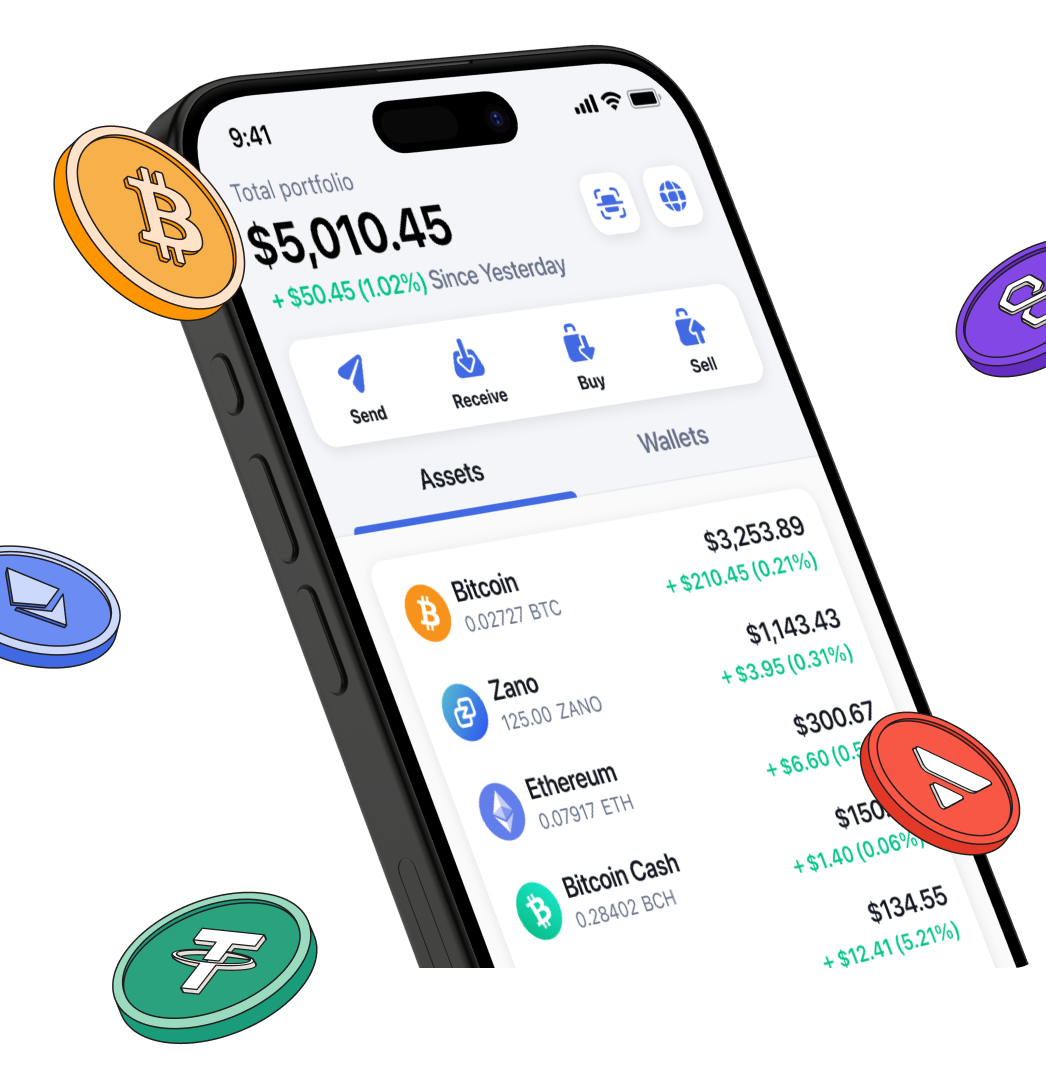
Start investing safely with the Bitcoin.com Wallet
Over wallets created so far
Everything you need to buy, sell, trade, and invest your Bitcoin and cryptocurrency securely



Download App


© 2026 Saint Bitts LLC Bitcoin.com. All rights reserved
Download App
Company
Insights
Products & Services
Reviews
Follow
© 2026 Saint Bitts LLC Bitcoin.com. All rights reserved
 Get Bitcoin